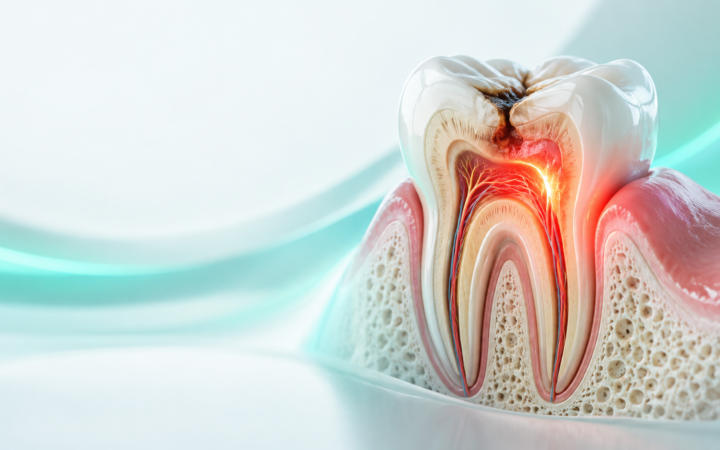
A cavity starts silently. By the time it hurts, the decay has usually reached the nerve — and what would have been a simple filling has become a root canal. These are the five signals worth acting on, roughly in the order they appear.
1. A twinge with sweet things
This is often the very first sign, and the one people dismiss most. Sugar draws fluid through the exposed dentine tubules, which the nerve registers as a brief sharp sensation.
At this stage the cavity is small and a filling takes fifteen minutes.
2. Sensitivity to cold that lingers
Everyone gets a brief jolt from something very cold. What matters is how long it lasts. A healthy tooth settles within a second or two. If the ache continues for ten seconds, or minutes, the pulp is inflamed — and inflamed pulp does not heal itself.
3. Food packing in one specific spot
If you find yourself reaching for a toothpick after every meal because food wedges in the same gap, something has changed shape there. Often it is decay eating away the contact point between two teeth.
Decay between teeth is invisible in the mirror and painless for a long time. It shows up on a bitewing X-ray, which is exactly why we take them.
4. A visible hole, dark spot or rough edge
A brown or black spot on the chewing surface, an edge that catches your tongue, or a visible pit. Some staining in the grooves of molars is harmless, but you cannot tell the difference by looking — a dentist checks whether the surface is soft.
Not all decay is dark. Early decay can appear as a chalky white patch, particularly around brackets in braces patients.
5. Pain on biting, or a bad taste
By this point the cavity is deep. Pain on biting suggests the decay has reached the pulp or the tooth has cracked around a weakened area. A persistent bad taste or smell from one spot points to bacteria in a deep cavity, or an abscess starting.
Facial swelling at this stage needs same-day treatment.
Why waiting costs so much more
Decay progresses through predictable stages, and the treatment escalates with it:
- Early enamel decay — reversible with fluoride and better cleaning. No drilling
- Into dentine — a simple filling
- Approaching the pulp — a deep filling, possibly a crown
- Into the pulp — root canal plus crown
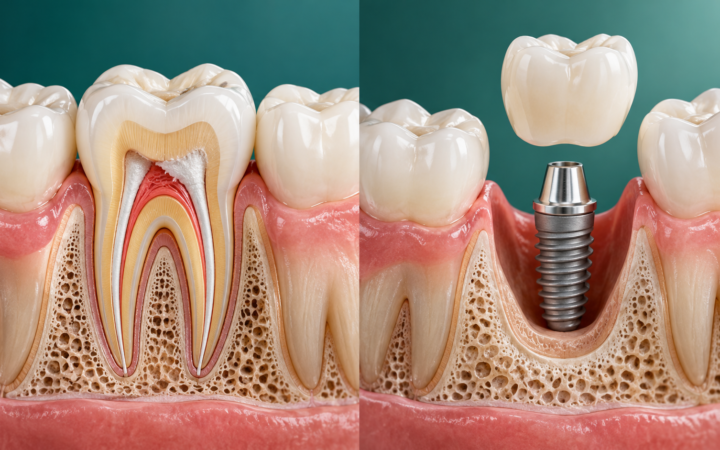
- Abscess and bone loss — root canal, or extraction and then an implant or bridge
Each step costs several times the one before it, and takes more of your time.
The uncomfortable truth about pain stopping
Sometimes a tooth aches badly for days and then goes quiet. People take this as recovery. It is not — it usually means the pulp has died. The infection is still there, now working its way into the bone, and it will return as swelling.
Prevention, honestly
- Brush twice daily for two minutes with fluoride toothpaste
- Clean between the teeth once a day — a brush cannot reach a third of each tooth
- Cut down how often you have sugar, not just how much. Sipping a sweet drink over an hour is far worse than drinking it quickly
- Check-up and scaling every six months
Read more on how tooth decay develops.
Booking a check-up while a cavity is still small is the cheapest dental decision you will ever make. Call 8359017239.