Wisdom teeth usually arrive between 17 and 25. When there is room, they come through and cause no trouble. When there is not, the early signs appear months before the pain does — and catching them early means a simpler procedure.
The earliest signs
A dull ache at the very back of the jaw
Often the first thing people notice. It comes and goes, is worse in the lower jaw, and is easy to dismiss. It is the tooth pressing against bone or the molar in front of it.
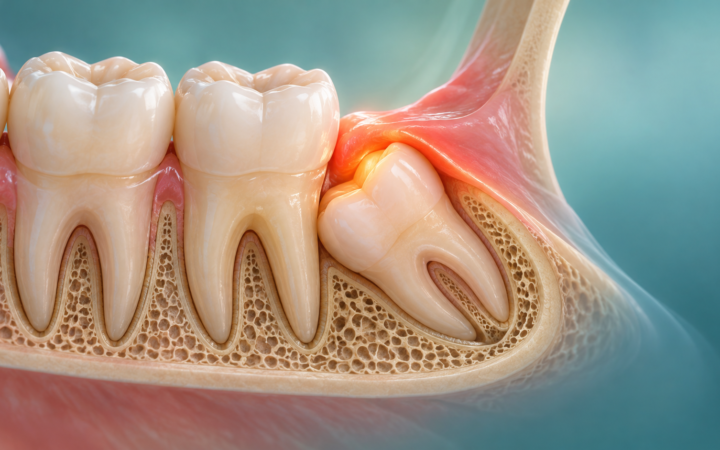
A swollen flap of gum over a partly erupted tooth
Look at the very back of your mouth in good light with a mirror. If you see a tooth partly through with a flap of gum over part of it, red or puffy at the edge, that is pericoronitis. Bacteria get under the flap and you cannot clean there.
It settles and returns repeatedly, and each episode tends to be worse.
Food packing behind your last molar
If food consistently wedges at the back and you cannot get it out, there is a trap forming between the wisdom tooth and the tooth in front.
A bad taste or smell from the back of the mouth
Discharge from beneath an infected gum flap.
Tenderness or slight stiffness on opening
Mild difficulty opening fully, or discomfort when you yawn. Early inflammation of the muscles near the site.
Pressure or crowding sensation
Some people describe a feeling of pressure at the back, or notice their lower front teeth becoming slightly more crowded. The evidence that wisdom teeth directly cause front-teeth crowding is weaker than commonly claimed, but a sense of pressure is worth mentioning.
The one that matters most, and shows no symptoms
Decay in the second molar — the perfectly good tooth directly in front of the wisdom tooth.
An angled wisdom tooth presses against the back surface of that molar, creating a spot that cannot be cleaned. Decay develops there, out of sight, painlessly, and by the time it is found the healthy molar may be badly damaged.
This is only visible on X-ray, and it is one of the more avoidable ways to lose a good tooth.
When it is already urgent
See a dentist the same day if you have:
- Swelling of the cheek, jaw or under the jaw
- Fever with the swelling
- Difficulty swallowing or breathing
- Inability to open your mouth more than a couple of centimetres
- Severe pain not responding to painkillers
Infection that has produced facial swelling has left the tooth and entered the surrounding tissue. It will not settle on its own, and in the lower jaw it can spread to spaces that compromise the airway.
What the X-ray tells us
An X-ray shows the angle of the tooth, the shape and number of its roots, how much bone covers it, whether decay has started in the neighbouring molar, whether a cyst has formed, and critically, how close the roots sit to the nerve running through the lower jaw. That relationship determines the surgical approach and is discussed with you before anything is scheduled.
Not every wisdom tooth needs removing
A wisdom tooth that is fully through, in a normal position, meeting an opposing tooth and cleanable should be left alone. It is a functional molar. We do not recommend removing healthy, symptom-free wisdom teeth.
Removal is indicated when the tooth is impacted and symptomatic, repeatedly infected, decaying or damaging the tooth in front, associated with a cyst, or occasionally when an orthodontic plan needs the space.
Why acting early is easier
Removing a wisdom tooth before it has been repeatedly infected, and while the roots are less fully formed in younger patients, is typically simpler with a quicker recovery. Waiting until there is acute swelling means treating the infection first and then operating.
Read what to expect from the extraction, or see our wisdom tooth page. Call 8359017239.