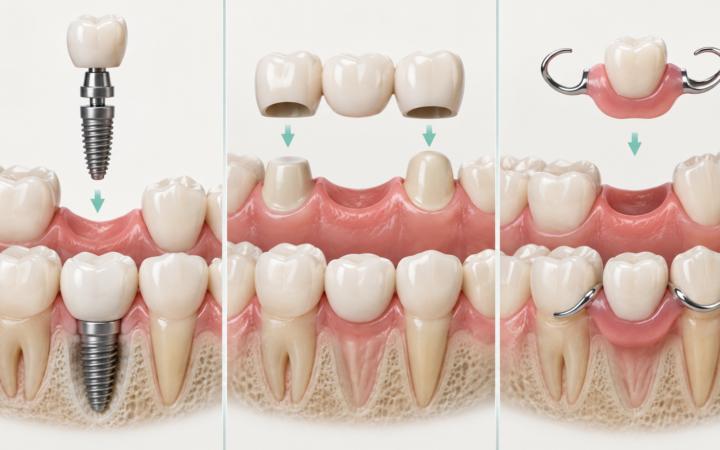
Crowns and bridges are the workhorses of restorative dentistry. A crown caps a damaged tooth and holds it together; a bridge fills a gap using the teeth either side as supports. Both are made in a laboratory and cemented permanently in place.
When you need a crown
- After a root canal on a back tooth. A root-treated molar has lost its blood supply and had material removed from its centre. It becomes brittle and can split under normal chewing — and a split root usually cannot be saved. Crowning it is not an upsell; it protects the treatment you just paid for
- When the tooth is heavily filled and more filling than tooth remains
- When the tooth is cracked — a crown holds the segments and stops the crack propagating
- After a large fracture
- When the tooth is badly worn from grinding
- To anchor a bridge, or to restore an implant
Materials
Zirconia — very strong, tooth-coloured, metal-free. Modern layered zirconia is aesthetic enough for front teeth and tough enough for molars. For most patients, this is the default.
All-ceramic (E-max and similar) — the best translucency and light behaviour, closest to natural enamel. Ideal for front teeth, used more cautiously on molars in grinders.
PFM (porcelain fused to metal) — long track record and durable, but the metal margin can show as a dark line as gums recede over years.
Full metal — strongest, needs the least tooth removal. Appearance rules it out at the front, but for a last molar in a heavy grinder it remains sensible.
What a bridge involves
The teeth either side of the gap are prepared for crowns, and the replacement tooth is joined to them as one solid unit that is cemented into place.
The trade-off to understand: healthy enamel is removed from those two supporting teeth, permanently. If they are already crowned or heavily filled, that costs nothing extra and a bridge is an excellent choice. If they are intact, an implant replaces the missing tooth without touching them — and we will usually recommend that instead.
See dentures compared for the removable alternatives.
The appointments
- Assessment and X-ray — confirming the tooth is restorable and the supporting bone is sound
- Preparation. Under local anaesthesia, the tooth is shaped to make room for the crown. An impression or digital scan is taken, and the shade matched against your natural teeth in good light
- Temporary crown fitted the same day, so you are never left with an exposed prepared tooth
- Fitting, one to two weeks later. The crown is tried in and checked for fit, contact with neighbours, bite and appearance — then adjusted before cementing
Speak up at the try-in if the shape or shade is not right. Changes then are easy; after cementation they are not.
Living with them
- Mild cold sensitivity for a week or two after fitting is normal
- If the bite feels high, come back. Two-minute adjustment. Leaving it causes soreness and can crack the crown
- You must clean under a bridge — superfloss or an interdental brush threaded beneath the false tooth, daily. Debris there causes gum inflammation and decay in the supporting teeth, which is the usual reason bridges fail
- Crowns cannot decay, but the natural tooth at the margin absolutely can. Brush that edge carefully
- Avoid ice, hard nuts and bones. Wear a night guard if you grind
How long they last
Ten to fifteen years is a common figure, and many last considerably longer. What ends them is decay at the margin, gum recession exposing the edge, and fracture from grinding — all three largely within your control.
If a crown comes off
Keep it safely and bring it in. A recently dislodged crown can very often be re-cemented rather than remade. Do not try to glue it yourself — household adhesives are toxic and prevent proper re-cementation.
Crowns and bridges at our Madan Mahal clinic — see crowns and bridges in Jabalpur or call 8359017239.