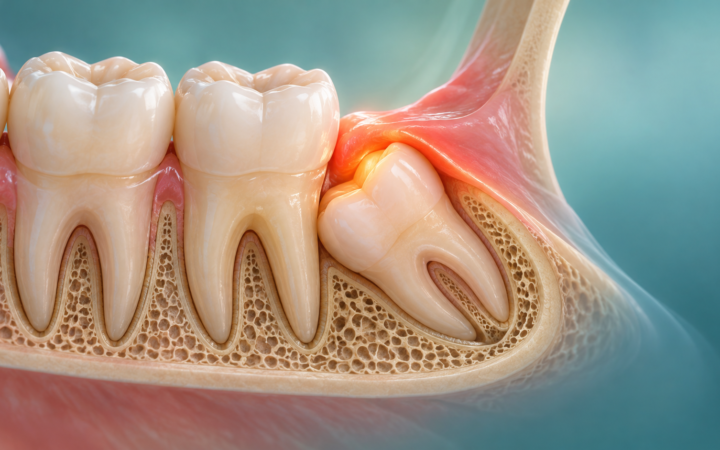
Wisdom tooth removal has an outsized reputation. For most patients it is a straightforward procedure under local anaesthesia with two or three uncomfortable days afterwards. Knowing what actually happens removes most of the anxiety.
Before: what we check
An X-ray comes first, always. It shows the angle of the tooth, root shape and number, how much bone covers it, and how close the roots sit to the inferior alveolar nerve in the lower jaw. That last point determines the approach and is discussed with you beforehand.
Tell us about: all medications, especially blood thinners; diabetes; heart conditions; any bleeding disorder; previous reactions to anaesthetic; and whether you are pregnant.
The procedure
- Anaesthesia. Topical gel, then local anaesthetic. You stay awake and the area is fully numb. You will feel firm pressure — that is normal and not pain
- Access. A fully erupted tooth is often simply lifted out. An impacted one needs a small incision and sometimes a little bone removed around the crown
- Sectioning. Impacted teeth are frequently cut into two or three pieces and removed piece by piece. This sounds alarming and is actually the gentler approach — it removes far less bone than lifting the whole tooth intact
- Closure. The socket is cleaned and stitches placed if needed, often dissolving ones
A straightforward extraction takes 15 to 20 minutes. A deeply impacted lower wisdom tooth may take 30 to 45.
First 24 hours — this determines your week
- Bite firmly on the gauze for 30 to 45 minutes. Some oozing afterwards is normal
- Do not rinse, spit forcefully, use a straw, or smoke. Each of these can dislodge the blood clot and cause a dry socket
- Cold compress on the cheek, 15 minutes on and 15 off
- Soft, cool food. Stay hydrated
- Take the painkillers before the anaesthetic wears off, not after the pain starts. This makes a real difference
- Rest with your head slightly raised
Dry socket — what it is and how to avoid it
The blood clot in the socket protects the exposed bone while healing begins. If it is dislodged, the bone is exposed and it is intensely painful, delaying healing by days.
The classic pattern is pain that worsens sharply on day three to five rather than improving, often with a bad taste. It is treatable — we clean and dress the socket — but far better avoided.
Smoking is the single biggest risk factor. Straws, forceful rinsing and spitting are the others. Avoiding all of them for 24 hours is the whole prevention strategy.
Days two to seven
- Begin gentle warm salt-water rinses from day two, after meals
- Swelling normally peaks around day two or three, then subsides. Bruising on the cheek can appear and is harmless
- Brush your other teeth normally; keep the brush away from the socket
- Complete any antibiotic course prescribed
- Avoid strenuous exercise, alcohol and smoking for several days
Call us if
- Pain worsens sharply on day three to five instead of improving
- Bleeding will not stop with firm pressure
- Swelling keeps increasing after day three, or you have fever
- You cannot open your mouth at all
- Your lip or chin is still numb after a few days
Realistic recovery
Most people take one day off and are comfortable enough for normal activity within two to three days. Swelling and jaw stiffness settle over about a week. The socket fills in with bone over several weeks, which you will not notice.
Plan an easy 48 hours. Do not book this two days before a wedding or an exam.
Practical points
- Eat beforehand unless told otherwise — you will not want to chew afterwards
- Arrange a lift home if you are anxious, though local anaesthesia alone does not prevent driving
- Buy your soft food in advance
- Ask whether both sides can be done together or should be separate; one side at a time leaves you able to chew
Read the early warning signs, or see our wisdom tooth removal page. Call 8359017239.