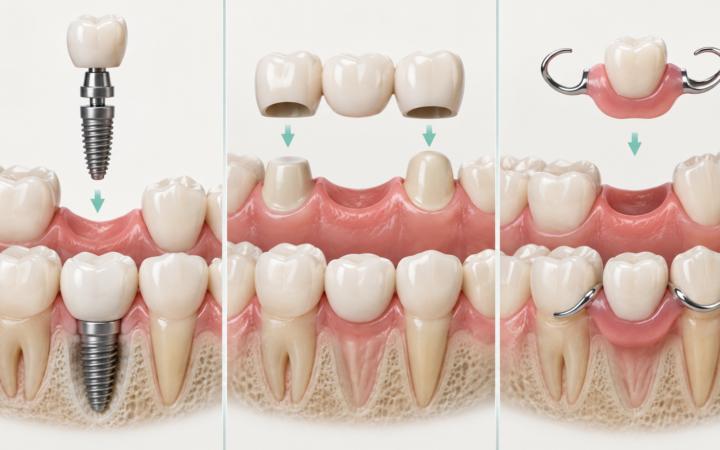
The distinction is straightforward — a complete denture replaces all the teeth in a jaw, a partial denture fills the gaps around teeth you still have. Which you need depends entirely on what remains, and there are good reasons to keep even a few natural teeth if you can.
Complete dentures
For a jaw with no remaining teeth. An acrylic base carrying a full arch of teeth, held by suction against the palate in the upper jaw, and resting on the ridge in the lower.
The upper works better than the lower. The palate gives a large surface for suction. The lower jaw has only a narrow horseshoe of bone with the tongue moving beneath — which is why so many people find their lower denture floats.
A full denture restores roughly a quarter of natural biting force. That sounds poor and it is the difference between a varied diet and living on soft food.
Full detail on our complete dentures page.
Partial dentures
For a jaw with some healthy teeth remaining. A framework carrying replacement teeth, clipped to the natural teeth with clasps or precision attachments.
Partials are substantially more stable than complete dentures, because your own teeth hold them in place rather than suction. They also chew better.
Types
- Cast metal partial — a chrome-cobalt framework. Thin, strong, and the best long-term option. The metal clasps may show on visible teeth
- Acrylic partial — cheaper, thicker, often used as a temporary while gums heal after extractions
- Flexible partial — nylon-based, no metal clasps, more comfortable and discreet. Cannot be relined easily and is unsuitable for large spans
Why keeping natural teeth matters
Even a handful of remaining teeth changes the outcome considerably:
- They anchor the denture, so it does not move while eating
- Their roots continue loading the bone, which slows the jaw shrinkage that goes on relentlessly under a complete denture
- The periodontal ligament around a natural tooth gives you feedback about bite pressure — you can feel what you are chewing
- Chewing efficiency is far better
This is why we will always look hard at whether a questionable tooth can be saved with a root canal and a crown before recommending full clearance.
The implant option
An implant-supported overdenture is the significant advance in this area. Two to four implants are placed and the denture clips onto them.
It stays put — no rocking, no adhesive — and biting force increases dramatically. The difference is greatest in the lower jaw, precisely where conventional dentures perform worst. If you have a lower denture that will not stay in, this is the answer, and it is the option we most often wish patients had known about earlier. See dental implants.
Adapting to either
Both take a few weeks. Expect sore spots in the first week or two — come in and we will relieve the exact point rather than you enduring it. Increased saliva settles within days. Speech feels odd initially, and reading aloud for ten minutes a day genuinely speeds it up.
Start with soft food cut small, chew on both sides simultaneously to keep the denture balanced, and add harder foods over a few weeks.
Care for both
- Remove and rinse after meals
- Brush daily with a denture brush and mild soap — not regular toothpaste, which is abrasive and scratches acrylic
- Clean over a basin of water; dentures shatter on hard floors
- Leave them out overnight in water. Gum tissue needs the rest
- With a partial, clean your remaining natural teeth meticulously — clasps trap plaque, and losing an anchor tooth means remaking the denture
Neither lasts forever
Bone under a denture resorbs, so the fit loosens over years. Expect a reline every few years and replacement at around five to seven. An old loose denture accelerates bone loss and causes ulcers — it is not harmless.
Denture assessment at Madan Mahal. Bring your current denture if you have one — a reline often solves the problem. Call 8359017239.