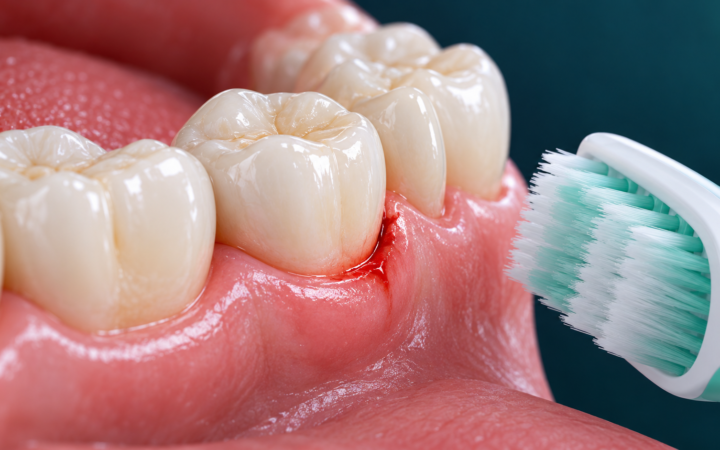
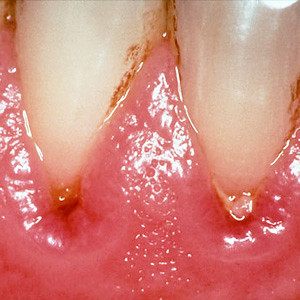
There is a well-documented association between gum disease and cardiovascular disease, including stroke. It is worth setting out honestly — what the evidence supports, what it does not, and why it is still a good reason to look after your gums.
What the research shows
Multiple large studies have found that people with periodontitis have a higher rate of cardiovascular events, including stroke, than people with healthy gums. The association persists after adjusting for shared risk factors like smoking and diabetes.
Three mechanisms are proposed:
- Chronic inflammation. Periodontitis maintains a long-running inflammatory state, and inflammation is central to how atherosclerotic plaques form and rupture
- Bacteria entering the bloodstream. Bleeding gums provide a route. Oral bacteria have been identified within arterial plaques
- Shared risk factors. Smoking, diabetes, poor diet and low physical activity drive both conditions
What it does not show
Association is not causation, and you should be sceptical of anyone claiming certainty here — including a dentist.
It has not been demonstrated that treating gum disease reduces stroke risk. Trials have shown that periodontal treatment improves markers of inflammation and blood vessel function, which is encouraging, but no trial has yet shown a reduction in actual stroke or heart attack rates.
The honest position: the association is real and consistent, the mechanisms are plausible, and the causal question is unresolved.
Why it is still worth acting on
Set the cardiovascular question aside entirely. Periodontitis is the leading cause of tooth loss in adults, it is painless until advanced, and the bone it destroys does not grow back.
That alone justifies treating it. Any cardiovascular benefit is a possible bonus, not the reason.
The clearer relationship: diabetes
Here the two-way link is much better established. Diabetes worsens gum disease, and gum inflammation makes blood glucose harder to control. Treating periodontitis produces measurable improvements in glycaemic control.
Since diabetes is itself a major stroke risk factor, this is arguably the more concrete connection.
After a stroke: practical dental care
Stroke survivors face specific difficulties that are often overlooked.
- Weakness on one side makes brushing difficult. An electric toothbrush helps considerably. Building up a manual handle with foam also works
- Food pocketing in the affected cheek — check and clear that side after every meal
- Reduced sensation means injuries and ulcers go unnoticed. Inspect regularly
- Dry mouth from stroke medication accelerates decay sharply — see dry mouth
- Swallowing difficulty raises the risk of aspiration pneumonia, and good oral hygiene measurably reduces that risk. This is one of the clearest, best-evidenced links between mouth care and general health
- Blood thinners — tell us before any extraction. Usually medication is not stopped; bleeding is managed locally
Practical takeaway
- Treat gum disease because it costs you teeth — that reason stands on its own
- If you have diabetes, gum treatment genuinely helps your control
- Do not stop cardiac or stroke medication for dental work. Tell us instead
- After a stroke, mouth care matters more, not less — particularly for pneumonia risk
- Be wary of any clinic promising that a scaling will prevent a heart attack. That is not what the evidence says
Signs of gum disease
Bleeding when brushing, red or swollen gums, persistent bad breath, receding gums, loose teeth, or a bite that feels different. Notably absent: pain.
See gum disease treatment or read how gum disease develops.
Tell us about all medical conditions and medications at your appointment. Call 8359017239.