Tooth decay is the most common chronic disease in the world, and also one of the most preventable. Understanding what actually causes it makes the prevention advice make sense — and explains why some people get cavities despite brushing twice a day.
How decay actually happens
Your mouth is full of bacteria. Some of them, given sugar, produce acid as a waste product. That acid dissolves minerals out of the enamel.
This happens after every meal and is completely normal. Saliva then neutralises the acid and returns minerals to the enamel — a process called remineralisation. Decay occurs when the balance tips: when acid attacks come so often that saliva never catches up.
This is why frequency matters more than quantity. One chocolate bar eaten in five minutes causes one acid attack. The same chocolate nibbled across an afternoon causes a dozen, and the enamel never gets to recover in between.
The stages
- White spot — minerals lost, surface still intact. Reversible with fluoride and better cleaning
- Enamel cavity — the surface collapses. Needs a filling. Usually painless
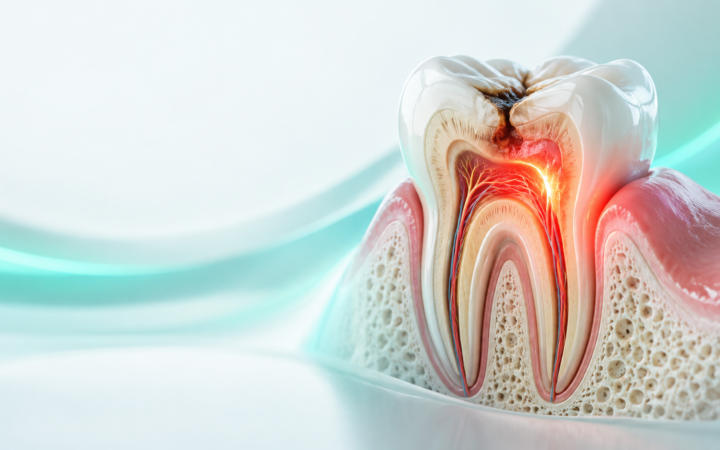
- Dentine decay — spreads faster, dentine is softer. Sensitivity begins
- Pulp involvement — the nerve is infected. Now a root canal
- Abscess — infection reaches the bone. Swelling, severe pain
Who is most at risk
- Frequent snackers and sippers — more than diet composition, this is the biggest behavioural factor
- People with dry mouth — from medication, dehydration or mouth breathing. Without saliva, decay accelerates dramatically. See our post on dry mouth
- Deep grooves in molars — some people simply have anatomy that traps plaque
- Crowded teeth — impossible to clean properly between
- Receding gums — exposed root surface decays far faster than enamel
- Children and older adults — for different reasons, both are higher risk
Signs to watch for
- Twinges with sweet, cold or hot food
- Food consistently packing in one spot
- A visible hole, dark spot or rough edge
- Pain on biting
- Persistent bad taste from one area
- Often, for a long time — nothing at all
Treatment
Fluoride application for early white spots, with improved home cleaning. No drilling needed.
Fillings for established cavities. Tooth-coloured composite bonds to the tooth and needs less healthy structure removed than older materials.
Crowns when so much tooth is gone that a filling would have no support. See crowns and bridges.
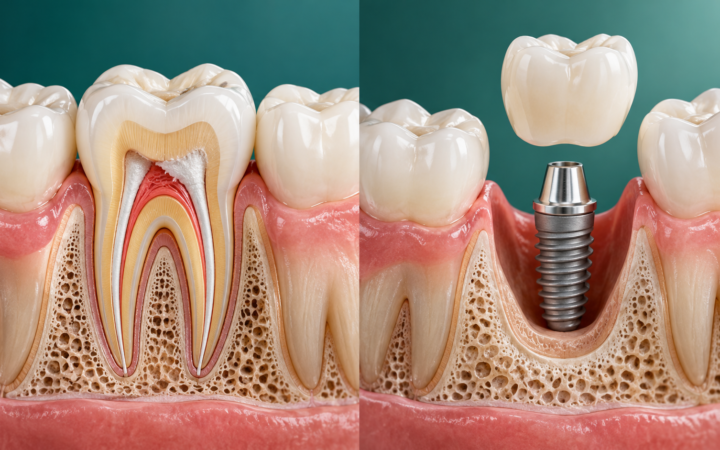
Root canal when the pulp is infected.
Extraction only when the tooth genuinely cannot be restored — and then we discuss replacing it, because a gap causes its own problems.
Prevention that actually works
- Fluoride toothpaste, twice daily, two minutes, soft brush, angled into the gum line
- Spit, don’t rinse. Rinsing with water immediately after brushing washes the fluoride away before it can work
- Clean between teeth daily
- Reduce snacking frequency; drink water between meals rather than sweet drinks
- Six-monthly check-ups with X-rays where indicated
The cheapest cavity is the one caught while it is still a filling. Book a check-up on 8359017239.