Root canal treatment has a reputation it no longer deserves. The pain people associate with it is the pain of the infection that sent them to the dentist — the treatment is what makes that stop. Here is exactly when you need one, and precisely what happens in the chair.
What a root canal actually does
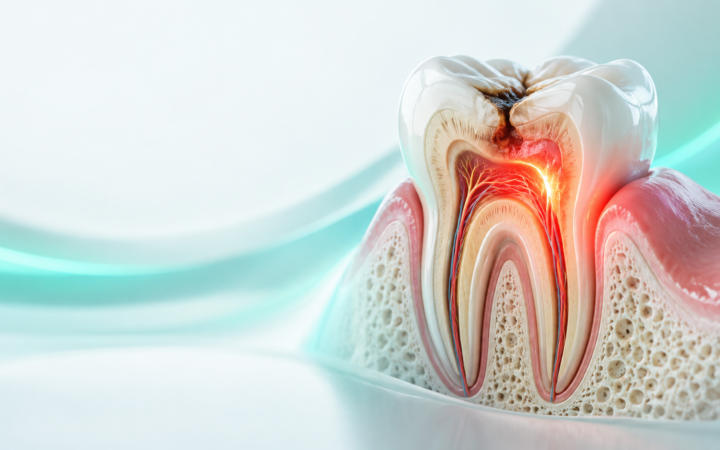
Inside every tooth is a soft core called the pulp, containing the nerve and blood supply. When decay works through the enamel and dentine, or a crack lets bacteria in, that pulp becomes infected. It does not recover. It dies, and the infection travels out through the root tip into the jawbone, forming an abscess.
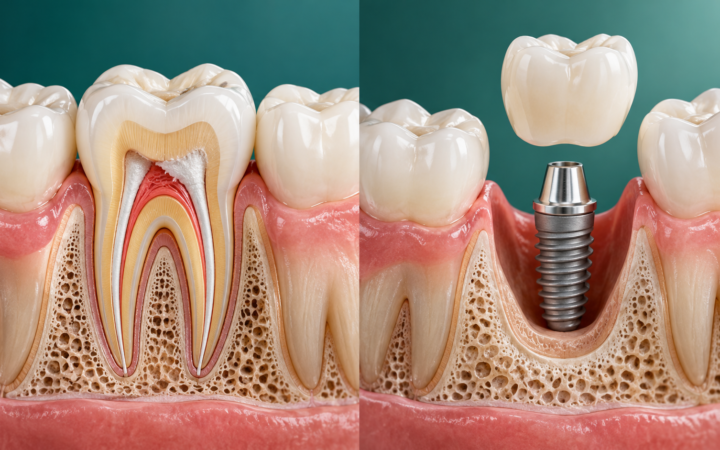
A root canal removes the infected pulp, disinfects and shapes the hollow canals, and seals them. The tooth stays in your mouth and keeps working. The alternative is extraction — quicker and cheaper on the day, but it leaves a gap that costs several times more to fill later with an implant or bridge.
Signs you need one
- Pain that lingers after something cold — a healthy tooth recovers in a second or two
- Pain that wakes you at night, or worsens when you lie down
- Sensitivity to heat specifically — hot tea causing a deep throb is a classic sign
- A pimple on the gum near the tooth that comes and goes, sometimes with a bad taste — that is an abscess draining
- Swelling of the gum, cheek or face — this needs seeing the same day
- A tooth gone grey compared with its neighbours, often years after a knock
- Pain on biting one specific tooth
Sometimes there is no pain at all. A pulp can die quietly and show up only as a dark shadow at the root tip on an X-ray taken for something else — one of several reasons a check-up every six months earns its keep.
Step by step: what actually happens
Step 1 — Examination and digital X-ray
We test how the tooth responds to cold and to tapping, and take a digital X-ray on site. That image shows how deep the decay runs, how many canals the tooth has, how curved they are, and whether infection has reached the bone. Read more about digital dental X-rays.
Step 2 — Anaesthesia
Topical numbing gel first, so the injection is barely felt, then local anaesthetic. We wait and test before starting. This step decides whether the appointment is comfortable, and it is not rushed.
Step 3 — Access opening
A small opening is made through the biting surface to reach the pulp chamber.
Step 4 — Cleaning and shaping
The infected pulp is removed and the canals cleaned with fine rotary files. An apex locator tells us electronically exactly where each root ends, so the canal is cleaned to its full length and no further. Disinfecting solution irrigates the canals throughout.
Step 5 — Sealing
Once clean, dry and shaped, the canals are filled with gutta-percha, a rubber-like material, and sealed. The access opening gets a filling.
Step 6 — The crown
This step matters more than most patients realise. A root-treated back tooth has lost its blood supply and had material taken from its centre, which makes it brittle. Without a crown, a molar has a real chance of splitting — and a split root usually cannot be saved.
How long does it take?
A front tooth with one straight canal takes around 45 minutes. A lower molar with three or four curved canals takes 60 to 90. Most cases here are finished in a single sitting. We use two visits when the tooth is actively swollen, because medicating the canal for a week gives a better result in those cases.
Afterwards
The tooth is often tender to bite on for two to four days as the ligament around the root settles. Ordinary painkillers handle it. If pain is severe or increasing, call us — that is not normal.
A well-done root canal with a proper crown can last the rest of your life. Brush and floss it like any other tooth; it cannot feel decay any more, so a new cavity at the crown margin gives you no warning ache.
Full details on our root canal treatment page, or in Hindi at Root Canal Jabalpur. If you have facial swelling or pain keeping you awake, call 8359017239 rather than waiting.